·3 min read
Bullet Lens: forensic topography in the browser
A short note on Bullet Lens, a browser-based viewer for .x3p bullet land scans, with interactive 3D inspection, stitched bullet views, and side-by-side comparison.
Bullet Lens is a small web app for looking at something that usually stays buried in specialist tooling: the microscopic topography of fired bullets.
When a bullet travels through a barrel, the rifling leaves fine striations on each land surface. Those marks are not literally a fingerprint, but they are close enough to make the metaphor useful: tiny, directional, physical traces that can help forensic examiners reason about whether two bullets may have passed through the same barrel.
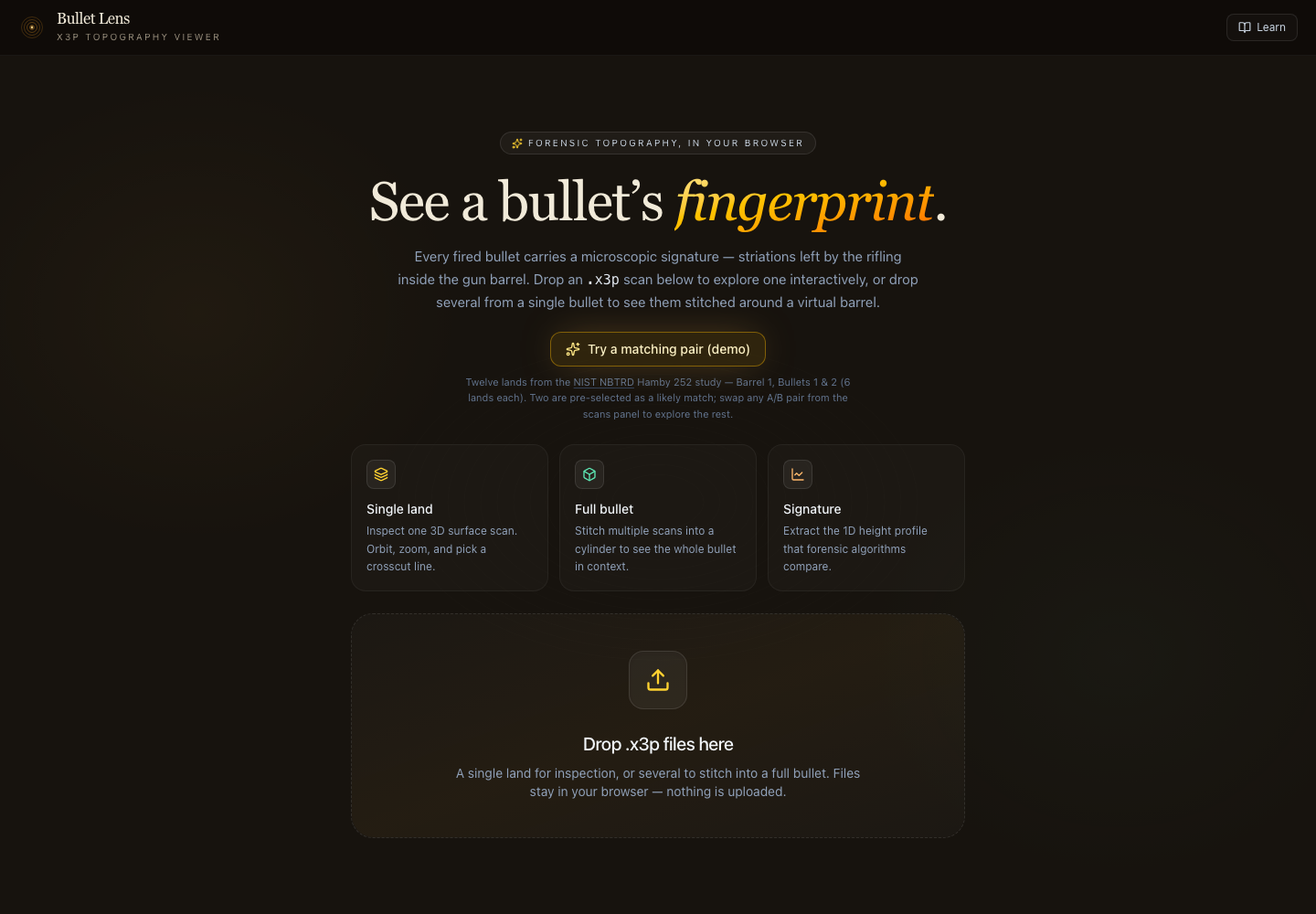
The app reads ISO 5436-2 .x3p topography scans directly in the browser. Drop in one scan and you
get an orbitable 3D surface, a real-world scale overlay, Z-exaggeration controls, and a live
crosscut signature. Drop in several scans from the same bullet and Bullet Lens can arrange them
around a virtual barrel so the individual land impressions are easier to understand in context.
The part I like most is that the inspection loop is immediate. There is no account, no upload step,
and no server-side processing for your own files. The browser unpacks the .x3p, parses the XML and
height matrix, builds the mesh, and lets you start poking at the surface.
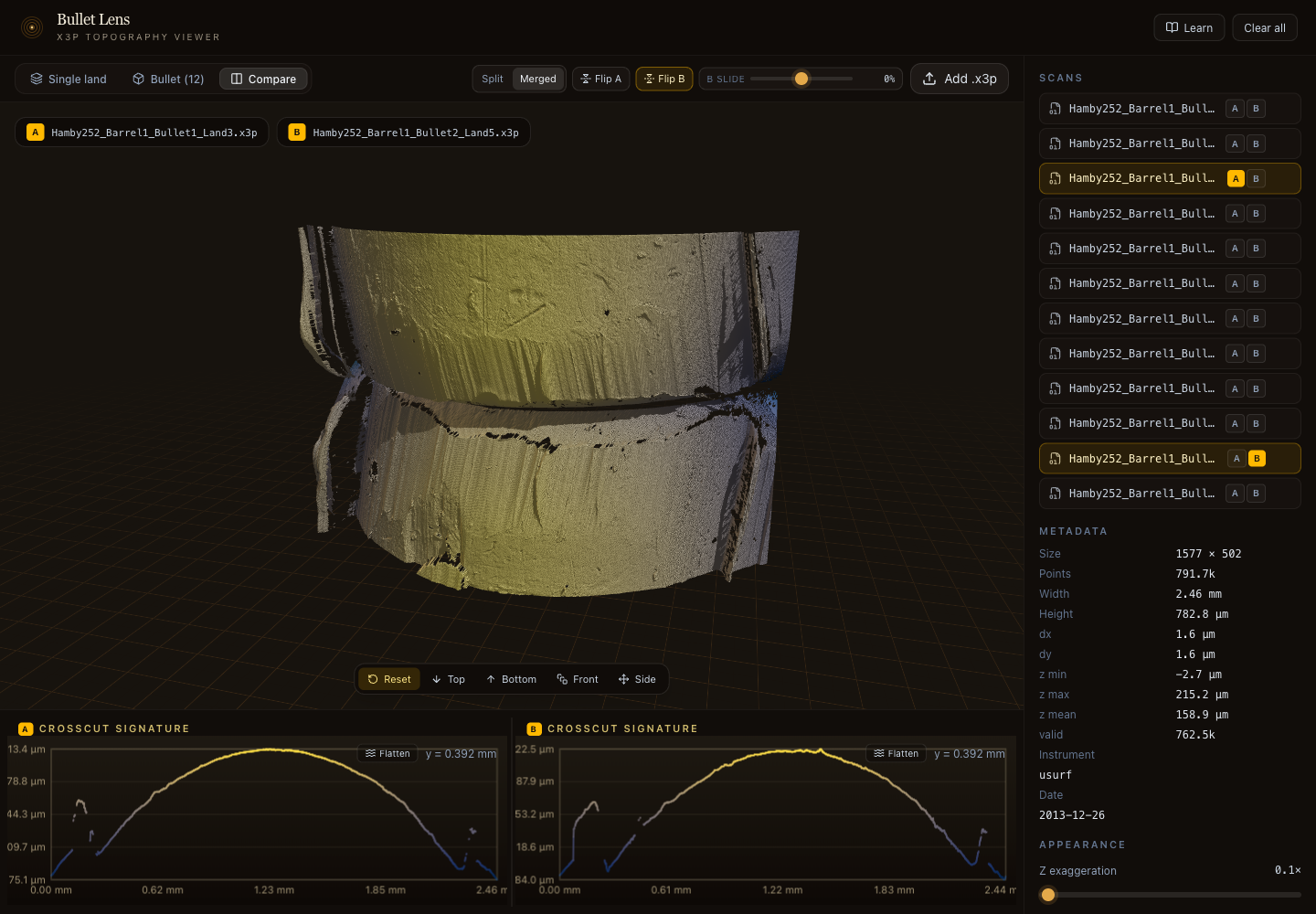
For comparison work, Bullet Lens has a split view and a merged view. The merged view stacks two land surfaces along a seam, lets you flip either side, and includes a horizontal B-slide control for lining up striae. Underneath, the crosscut plots show the one-dimensional height signatures that many automated comparison methods eventually care about.
There is also a built-in demo using Hamby 252 scans from the NIST Ballistics Toolmarks Research
Database, so the app is explorable even if you do not have .x3p files sitting around.
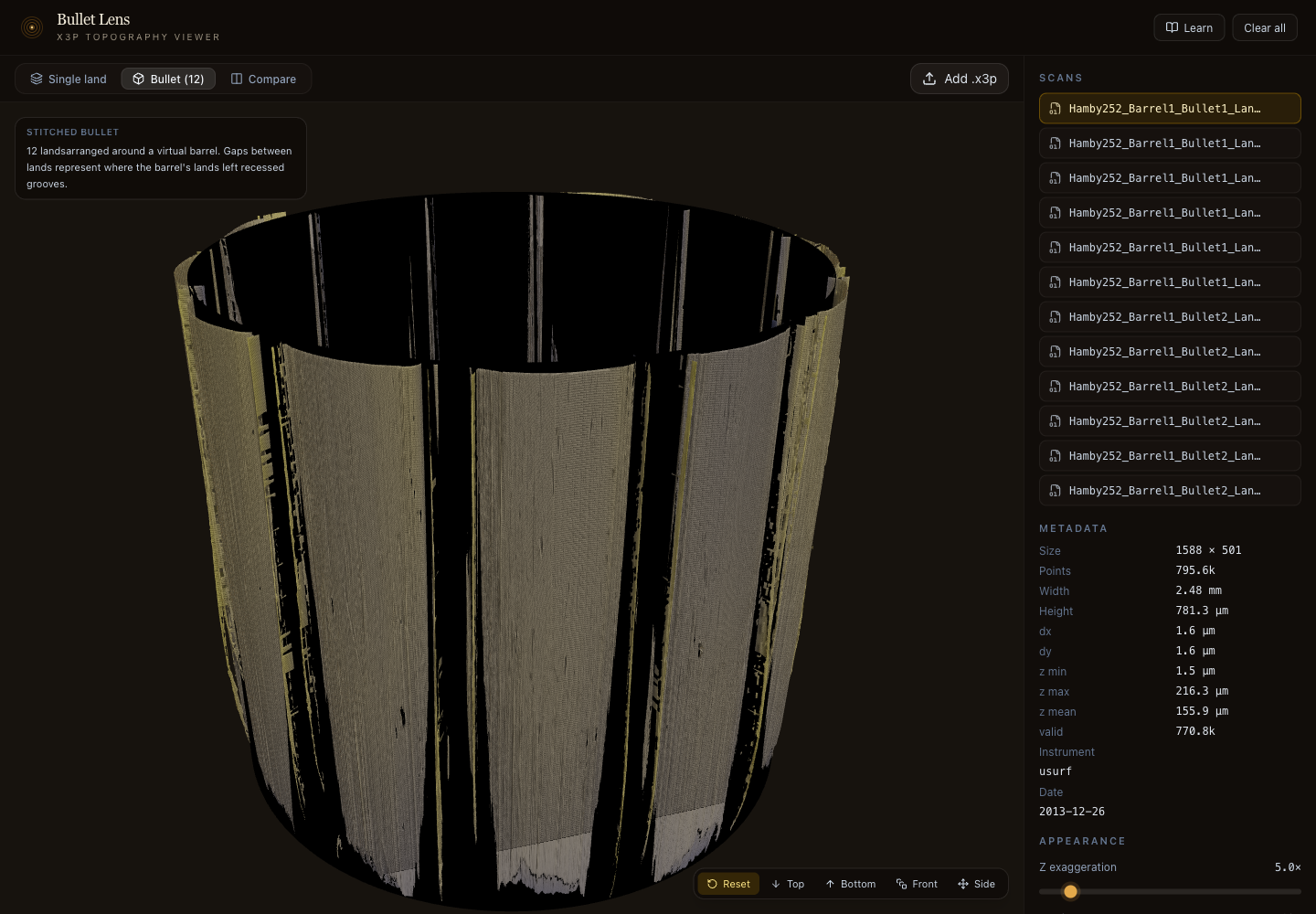
The stitched bullet view is deliberately a little opinionated. A real land surface is only a few microns tall across millimeters of width, so raw geometry can be visually underwhelming. Bullet Lens keeps the overall barrel curvature readable while letting the surface detail breathe through exaggeration and colormaps.
This is very much a browser-native tool: Next.js, React Three Fiber, Three.js, Tailwind, fflate,
and Zustand. But the interesting part is less the stack than the interaction shape. For forensic
topography, being able to drag in data, rotate it, stitch it, compare it, and extract signatures in
one place makes the data feel less like a file format and more like an object you can study.
Try it here: bullet-lens.vercel.app.