
Co-advisor
Heike Hofmann
Professor of Statistics at Iowa State and long-time collaborator on the bullet-matching methodology and the downstream R tooling.
Iowa State University · 2012 — 2017 · Statistics & Computer Science
My dissertation translated the comparison of microscopic toolmarks into an open, end-to-end statistical pipeline operating on 3D surface scans. The resulting methods, software, and publications are now part of theCSAFE research program and have been cited in the ongoing debate over the scientific foundation of pattern-matching forensic disciplines.
The problem
When a bullet is fired, the barrel leaves fine striations on its surface — tool marks that are, in principle, characteristic of that barrel. Traditional firearms identification asks a human examiner to look through a comparison microscope and decide whether two bullets match. The decision is binary, the rationale is verbal, and the error rate has historically been opaque.
The 2009 NAS report and 2016 PCAST report both singled out pattern-matching forensic disciplines for lacking empirical foundations. You cannot argue about error rates on a method until the method is written down precisely enough to run twice. My dissertation set out to write it down.
The pipeline
Every step is code you can run, not a judgement call you can't audit.
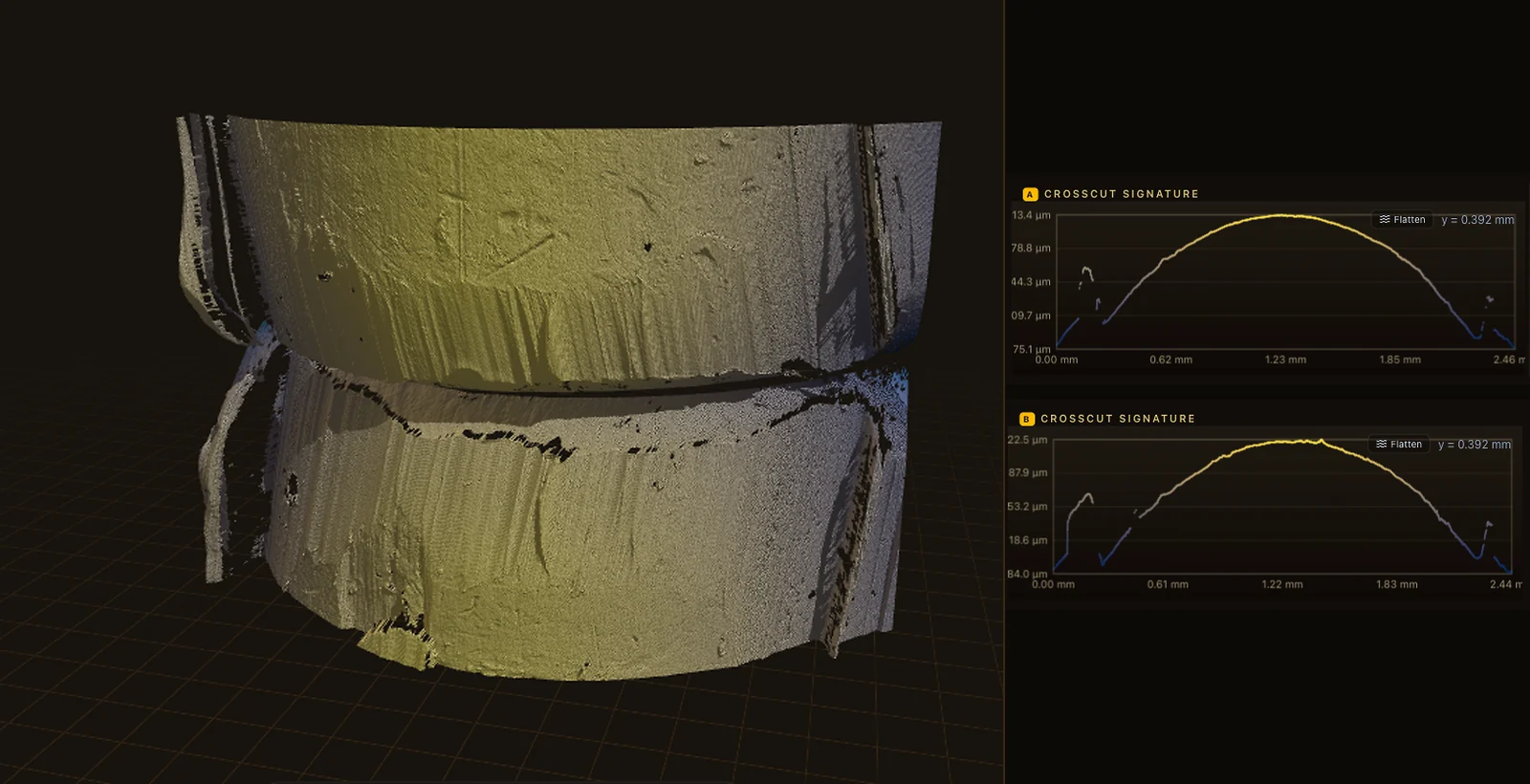
High-resolution 3D surface scans of spent bullets — sub-micron vertical resolution across the land-engraved area.
Isolate land-engraved areas, detrend the bullet curvature, and pull out the 1D striation signature for each land.
Pairwise cross-correlation aligns striation signatures between lands, robust to shifts and degradation.
A model over features of the aligned signatures measures similarity and supports calibrated statements about evidentiary strength.
What shipped
Reference R package for reading 3D bullet scans, extracting striations, and scoring matches — the first open, reproducible implementation of the pipeline.
Feature-extraction toolkit separated from the core package for maintainability and reuse across CSAFE tooling.
Published in the Annals of Applied Statistics and Law, Probability & Risk, with source code released alongside the papers.
A Shiny app that lets examiners upload scans and step through the matching pipeline interactively.
Publications
Eric Hare, Heike Hofmann, Alicia Carriquiry
Annals of Applied Statistics
ASA Imaging Section Student Paper Award, 2016
A reproducible pipeline for matching bullet land engravings from high-resolution 3D surface scans, with a statistical model for scoring matches.
doi: 10.1214/17-AOAS1080
Eric Hare, Heike Hofmann, Alicia Carriquiry
Law, Probability and Risk
doi: 10.1093/lpr/mgx018
Timeline
2012
Started the PhD at Iowa State, joining Heike Hofmann and Alicia Carriquiry.
2014
First working prototype of the striation-extraction pipeline in R.
2015
CSAFE launched; the bullet-matching work became part of its founding research portfolio.
2016
ASA Imaging Section Student Paper Award for the automated matching methodology.
2017
Thesis defended; primary paper published in the Annals of Applied Statistics.
Today
Still an occasional collaborator on CSAFE’s BulletAnalyzr pipeline — and the work continues as Verity, an open forensic-comparison engine built on calibrated likelihood ratios.
People
Co-advisor
Professor of Statistics at Iowa State and long-time collaborator on the bullet-matching methodology and the downstream R tooling.
Co-advisor
Distinguished Professor and founding director of CSAFE — the Center for Statistics and Applications in Forensic Evidence.
Research home
NIST Center of Excellence. The bullet-matching work continues there under theBulletAnalyzr umbrella.
Still interested?
If you're working on pattern-matching evidence, reproducible pipelines, or the R tooling around any of it — I'm building in this space again withVerity, an open engine for calibrated forensic comparison.