·6 min read
Verity: weighing the marks, not calling the match
Introducing Verity, an open, domain-general engine for forensic surface comparison — transparent, calibrated likelihood ratios from 3-D scans of bullets, cartridge cases, and toolmarks.
In 2012 I started a PhD with a strange job description: figure out whether a spent bullet can be matched to the gun that fired it, statistically, from a 3-D scan of its surface.
I spent five years on that question. I wrote R packages, scanned bullet lands, extracted striations, scored comparisons, defended a thesis, and watched the work fold into CSAFE’s research portfolio. Then I went off and built developer tools and AI platforms for a decade.
The question never let go.
Here is the thing that stuck with me: when a firearms examiner testifies, the jury hears the word “match.” And the honest version of that word — the one a statistician would sign — does not exist yet. Courts have started noticing. Abruquah v. Maryland (2023) pushed back on unqualified identification testimony. Federal Rule of Evidence 702 was amended the same year to tighten what expert conclusions are supposed to survive. And as Cuellar et al. put it in 2024, no pattern-comparison discipline yet has a well-characterized error rate.
Meanwhile, the tooling landscape is split between subjective examiner judgment, proprietary black-box correlation systems, and a pile of open but domain-specific research packages — some of which I wrote.
So I built Verity.
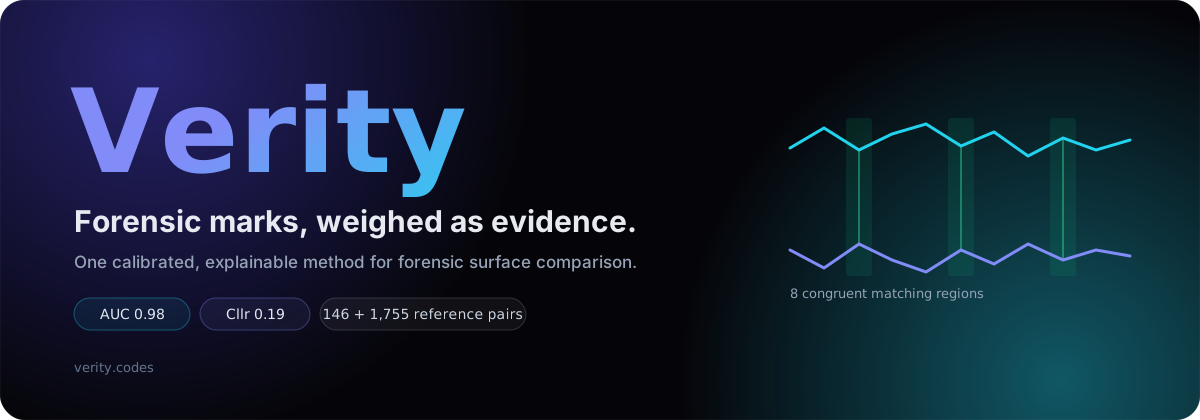
Not a verdict, a weight
Verity compares 3-D surface-topography scans — bullet lands, cartridge-case breech-face impressions, striated and impressed toolmarks — directly from X3P files, the ISO 25178-72 standard format. What it refuses to do is say “match.”
What you get instead is a ComparisonReport:
{
  "likelihood_ratio": 146.0,
  "verbal": "moderately strong support for same source",
  "lr_bound_log10": 2.16,
  "reference": { "name": "pooled bullet-land", "n_km": 146, "n_knm": 1755, "auc": 0.984, "cllr": 0.193 },
  "attribution": [ /* the matched regions — the explanation */ ],
  "scope_note": "Not a claim about the error rate of examination, which remains unknown."
}
Every piece of that is deliberate. A likelihood ratio instead of a binary call. A verbal equivalent so the number is reportable in plain language. A named reference population with its measured discrimination and calibration cost, so the claim is characterized rather than asserted. An ELUB bound that caps how strong a statement the data can support no matter how enthusiastic the score is. And region-level attribution, so you can see which parts of the surfaces carried the evidence.
The design principle underneath: statistics decide, not a black box. A representation — classical metrology today, learned features eventually — produces a score. A transparent, ELUB-bounded calibration turns that score into evidence. Because the decision layer is interpretable on its own terms, the report stays auditable regardless of how the score was computed. That is the firewall.
One method, many marks
The comparison method is something I am calling Congruent Matching Regions (CMR). It generalizes Song’s Congruent Matching Cells — the standard cartridge-case method — from 2-D cells under a fixed translation+rotation to regions of any dimension under any transformation group.
Partition a mark into regions. Register each region against the other mark. Count the regions that agree on one common geometry. For striated marks with 1-D profile windows, this reduces to the Chumbley/CMS-style tests I worked with in graduate school. For impressed marks with 2-D grid cells, it reduces exactly to CMC. For fractured surfaces with 3-D mesh patches, it becomes a research direction. Same algorithm, three domains — and the congruent regions are the attribution map, so the explanation falls out of the method instead of being bolted on.
The plumbing matters too
A decade of platform work left me with opinions about research code, and Verity is where I am acting on all of them.
The foundation is verity-x3p, a Rust crate that is the single source of truth for reading and
writing X3P files. Python gets it through PyO3 with NumPy arrays; R gets it through extendr with
an x3ptools-compatible layout. A file written from any binding reads back bit-identically in
every other. On top of that sit the Python metrology engine — ISO 16610 preprocessing,
registration, CMR, the calibrated-LR decision layer — a FastAPI comparison API, a normalized
scan catalog with content-addressed storage, and a Next.js app.
Everything is deterministic, version-pinned, and content-hashed, because a forensic result you cannot reproduce is not a result. And the whole comparison is one HTTP call:
curl -s -X POST https://api.verity.codes/compare \
  -F domain=striated \
  -F mark_a=@bulletA_land1.x3p -F mark_a=@bulletA_land2.x3p \
  -F mark_b=@bulletB_land1.x3p -F mark_b=@bulletB_land2.x3p
The honest part
Validation is where forensic tools usually get vague, so this is the section I care most about.
The headline result: under a barrel-disjoint protocol — no barrel appears in both training and test, reported per study, never pooled across makes — the first-principles scorer reaches AUC ≈ 1.00 with a test Cllr ≈ 0.11 on Hamby-252, and Cllr ≈ 0.11–0.35 at AUC ≈ 0.97–1.00 across the four NBTRD bullet studies. That is an informative, calibrated weight of evidence from metrology alone, with the calibration loss measured on the split that actually stresses it.
The less flattering result, stated just as plainly: the learned representation does not beat the cross-correlation baseline yet. Trained barrel-disjoint on 210 Hamby scans, its held-out AUC collapses to about 0.67 — it overfits. Synthetic tests confirm the pipeline learns when there is enough signal, so this is a data limit rather than a defect, and the fix is more scans, not more spin. But the number is in the README, because a project about honest evidence does not get to bury its own.
And the scope note appears everywhere for a reason: none of this is a claim about the error rate of forensic examination. That remains unknown. Verity characterizes the error rate of one named method on named data — which is exactly the thing the field has been missing.
A very old question, upgraded
My dissertation work was one discipline, one language, one pipeline. Verity’s bet is bigger: one general, calibrated, explainable method, proven first where ground truth is strongest — firearms, where test fires give you real same-source labels — and then transferred to toolmarks, footwear, and fractured surfaces, where it is weakest.
Grad-school me would have killed for this platform. Present me gets to build it with a Rust core, a real API, and ten more years of statistical caution.
The app is live at verity.codes, the API reference at api.verity.codes/scalar, and the code — MIT/Apache-2.0 — at github.com/erichare/verity. If you have X3P scans, bring them. If you have opinions about likelihood ratios in the courtroom, I want to hear those too.